
1. 서론
This manual provides essential instructions for the safe and effective use of your URIT PFS-30/PFS-30A 5-in-1 Lipid Test Kit. This device is designed for rapid and comprehensive lipid panel testing, offering results for Total Cholesterol, Triglycerides, HDL, LDL, and the TC/HDL ratio from a single blood samp르.
The kit is engineered for ease of use, requiring only a minimal blood sample and providing results in approximately 2 minutes. It also features an integrated memory for storing up to 300 test results with time and date stamps, enabling convenient health trend tracking.
Important: This device is for informational purposes and should not replace professional medical advice or diagnosis. Consult your healthcare provider for interpretation of results and any health concerns.
2. 패키지 내용
Verify that all items listed below are present in your URIT 5-in-1 Lipid Test Kit package:
- URIT PFS-30A Lipid Test Meter (Monitor)
- 랜싱 장치
- Test Strips (10 Cholesterol Test Strips included)
- 모세관
- 랜싯
- Code Card (for test strip alignment)
- 보관 가방
- 사용 설명서

3. Setup and First-Time Use
3.1 시간 및 날짜 설정
When using the device for the first time, you will need to set the current year, month, and day. This ensures accurate time-stamping of your test results.
- Press the 'M' or 'S' buttons to adjust the year, month, and day.
- Press the middle button (power button) to confirm each setting.
- After setting the time, the device will automatically shut down.
3.2 채혈기 준비
The lancing device is used to obtain a small blood sample. Follow these steps to prepare it:
- Rotate the front of the lancing device to remove the cap.
- Insert a new lancet firmly into the lancing device.
- Gently twist and remove the protective cap from the lancet.
- 채혈 장치의 캡을 다시 닫으세요.
- Rotate the rear of the lancing device to set the penetration depth (usually 1-5, adjust as needed for your skin type).
- Pull back the grey end of the lancing device until it clicks, indicating it is cocked and ready for use.
3.3 Checking the Code
Each batch of test strips comes with a code card. It is crucial to ensure the code displayed on the meter matches the code on your test strip vial for accurate results.
- With the device turned OFF, insert the code card into the test strip slot.
- Turn on the device. The code will be displayed on the screen.
- Compare this code with the code printed on your test strip vial. If they match, you can proceed with testing. If they do not match, do not use the test strips and contact customer support.
4. 사용 설명서
4.1 Blood Samp르 컬렉션
Proper blood collection is essential for accurate results. Follow these steps carefully:
- 비누와 따뜻한 물로 손을 깨끗이 씻은 후, 완전히 말리세요.
- Disinfect the chosen fingertip (typically the side of the ring or middle finger) with an alcohol swab and allow it to air dry.
- Hold the prepared lancing device firmly against the disinfected fingertip and press the launch button to prick the finger.
- Gently squeeze the finger to form a round drop of blood. Wipe away the first drop of blood with a clean tissue or cotton swab.
- Gently squeeze again to form a second, larger drop of blood.
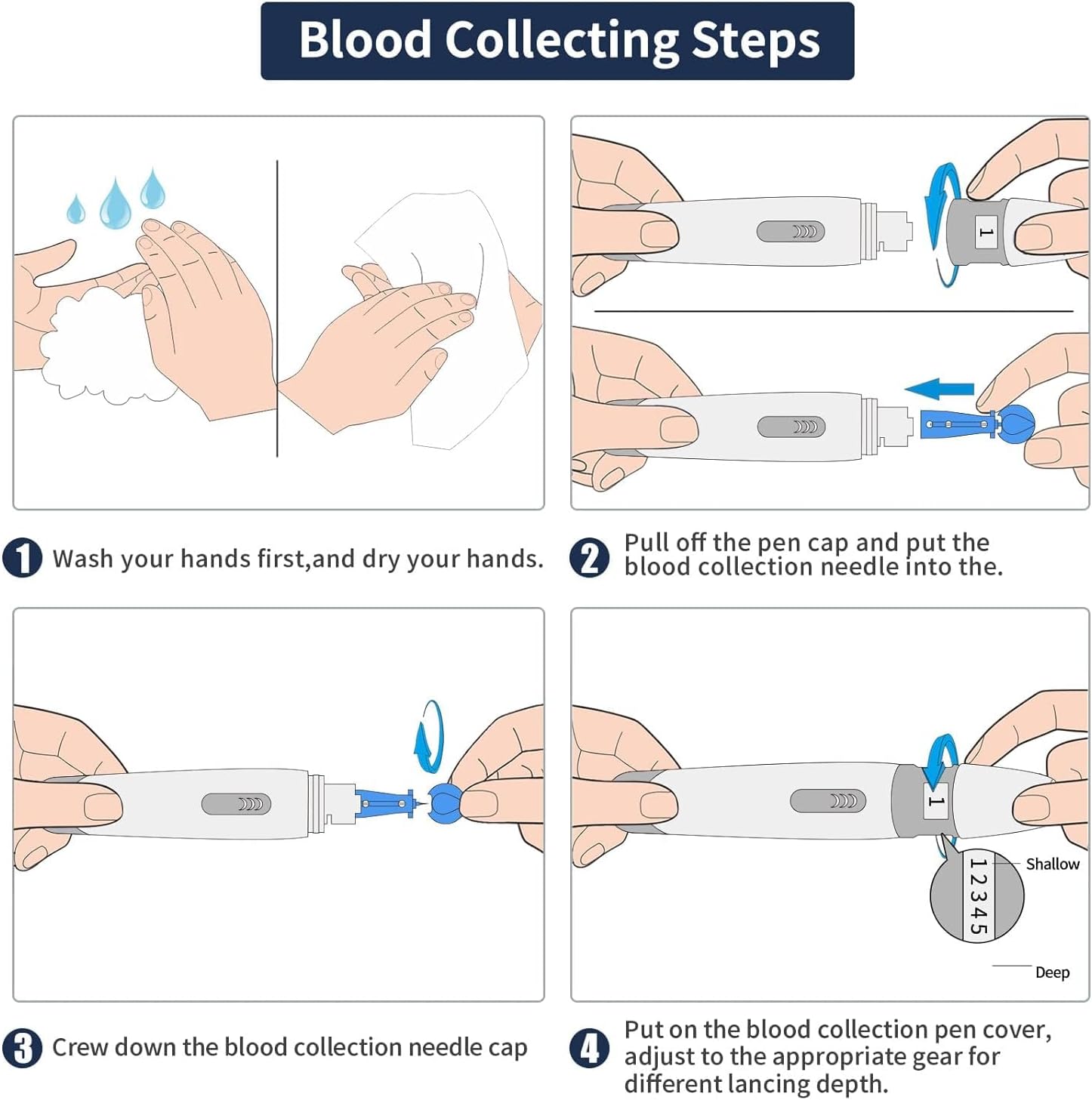
4.2 검사지에 혈액 도포하기
Once you have a sufficient blood sample, apply it to the test strip:
- Turn on the device and insert a test strip into the testing slot. Ensure the white round hole on the strip is facing up.
- When the blood drop symbol on the screen is flashing, apply the blood sample to the test hole of the strip. You can either directly drop the blood or use a capillary tube/pipette to transfer it.
- Ensure a full sample is applied at once. Small amounts over several drops can lead to incorrect results.

4.3 읽기 결과
After applying the blood sample, the device will begin its analysis:
- The device screen will show a countdown animation.
- Wait for approximately 2 minutes for the results to be processed.
- The results for Total Cholesterol, Triglycerides, HDL, LDL, and TC/HDL ratio will be displayed on the screen. Use the 'S' button to cycle through the different parameters.

4.4 결과 이해하기
The URIT PFS-30/PFS-30A provides a comprehensive lipid panel. Consult your healthcare provider for personalized interpretation of your results and to understand what your numbers mean for your health.
- Total Cholesterol (TC): 혈중 콜레스테롤 총량.
- Triglycerides (TG): A type of fat found in your blood.
- High-Density Lipoprotein (HDL): Often called "good" cholesterol.
- Low-Density Lipoprotein (LDL): Often called "bad" cholesterol.
- TC/HDL Ratio: The ratio of total cholesterol to HDL cholesterol.


5. 데이터 저장
The URIT PFS-30/PFS-30A meter has an internal memory capable of storing up to 300 of your most recent test results. Each record includes the test value, along with the corresponding time and date stamp.
다시view past results, press the 'M' button when the device is on. You can navigate through the stored data using the 'M' and 'S' buttons.

6. 유지관리
6.1 계량기 청소
To ensure the longevity and accuracy of your device, keep it clean:
- 계량기 외부를 부드러운 천으로 닦으십시오.amp 옷감.
- 독한 화학 약품이나 연마성 세척제를 사용하거나 기기를 물에 담그지 마십시오.
- Ensure the test strip slot is free from dust or debris.
6.2 보관
Store the URIT Lipid Test Kit and all its components in a cool, dry place, away from direct sunlight and extreme temperatures. Keep it out of reach of children.
- Store test strips in their original vial with the cap tightly closed to protect them from moisture.
- 유효기간이 지난 시험지를 사용하지 마세요.
7. 문제 해결
If you encounter issues with your URIT Lipid Test Kit, refer to the following common problems and solutions:
| 문제 | 가능한 원인 | 해결책 |
|---|---|---|
| 미터가 켜지지 않습니다 | 배터리 부족 또는 방전 | 배터리를 새것으로 교체하세요. |
| 오류 메시지가 표시됩니다 | Incorrect code, insufficient blood sample, expired strip, or strip inserted incorrectly. | Verify code, re-test with a new strip and sufficient sample, check strip expiration date and insertion. |
| 일관되지 않은 결과 | 부적절한ample collection, environmental factors (temperature), or expired strips. | Ensure proper technique, test in recommended temperature range, use fresh strips. |
| Code on meter does not match strip vial | Using the wrong code card or strips from a different batch. | Ensure you are using the code card that came with the current batch of test strips. Do not use strips if codes do not match. |
If the problem persists after attempting these solutions, please contact URIT customer support.
8. 사양
- 제품 이름: URIT 5-in-1 Lipid Test Kit
- 모델: PFS-30A
- 테스트 매개변수: Total Cholesterol, Triglycerides, HDL, LDL, TC/HDL Ratio
- 결과 시간: 약 2분
- Samp르 볼륨: 35~40μL
- 메모리 용량 : Up to 300 test results with time and date stamps
- 전원: (Not specified in input, typical for such devices is AAA batteries)
- 작동 온도: (Not specified in input, refer to device packaging)
- 보관 온도: (Not specified in input, refer to device packaging)
- 패키지 크기: 7.13 x 6.02 x 2.72 인치
- 패키지 무게: 14.89 온스
- 제조업체: URIT
9. 보증 및 지원
For warranty information, technical support, or any questions regarding the URIT PFS-30/PFS-30A 5-in-1 Lipid Test Kit, please refer to the warranty card included in your package or contact URIT customer service directly. Contact details can typically be found on the product packaging or the official URIT web대지.
Please note that statements regarding dietary supplements have not been evaluated by the FDA and are not intended to diagnose, treat, cure, or prevent any disease or health condition.